-2024-10-29317.jpg)
How Much Deposit Should You Ask For on a Job?
Learn more about the perfect deposit strategy for tradesmen and Service Providers in Portugal! Find the ideal balance be...

The statistics on business failure are alarming: 96% of businesses fail within 10 years, with 80% failing within the first two. Even among the 4% that survive, many are not necessarily successful or profitable. Moreover, 95% of companies never reach higher revenue milestones.
Let's get one thing straight: the root cause of this dismal performance is not the economy, the competition, or even market conditions. The real problem lies within the businesses themselves. Here’s why most businesses miss the bigger market and, ultimately, fail.
Too many business owners waste time on trivial tasks that could easily be delegated or outsourced. Instead of focusing on how to effectively market their business and consistently generate revenue, they get bogged down in minutiae. It’s time to focus what really matters. Your primary job is to drive growth, not handle every little chore.
Some businesses believe that merely existing on Google, social media, and having a website counts as marketing. Occasionally posting an infographic that says, "We are here, come and buy from us," or running an ad in a local newspaper with a poorly tailored message isn’t marketing—it just doesn’t cut it. Real marketing requires a strategic, targeted approach that engages potential customers and drives them to take action.
Imagine this: a potential customer wants to visit your business location I.e store, restaurant, or office, and you open whenever you want. Inconsistency breeds frustration and drives customers away. Establish regular business hours and stick to them. Your customers need to know when they can rely on you.

Failing to answer the phone or return calls is unacceptable. If you can't manage the basics of communication, why should a customer trust you with their business? Prompt, professional communication is non-negotiable.
Providing poor quality service when better options and materials are available is inexcusable. It’s shocking how many clients accept subpar work, which then becomes the norm. For example, plumbers taking shortcuts on new installations—this isn't just bad practice, it's a disservice to your customers and damages the industry’s reputation.
Too many service providers misrepresent their skills. Just because someone has worked in construction doesn't make them a qualified builder. Professionalism and proper qualifications matter. If you’re not genuinely skilled, you’re setting your business up for failure and letting your customers down.
Businesses often fail to follow up with leads. Following up doesn’t mean being pushy; it means building relationships and showing potential customers that you value their interest.
When I was renovating my house, none of the flooring companies followed up despite clear buying signals. I visited three different suppliers, asked all the questions, and provided my email for quotations, which arrived after three days. While comparing prices for a particular brand, I found significant differences despite it being the same product. I chose the reasonably priced option and never heard back from the other two companies.
This is a missed opportunity. Relationships and sales are built through consistent, thoughtful communication.
Some business owners are too laid back, failing to deliver on promises. Working at your own pace is fine, but it cannot compromise customer commitments. A lack of urgency, despite agreed deadlines, demonstrates a lack of professionalism and can drive customers away.
Punctuality matters. If you set an appointment for 10 a.m., show up at 10 a.m., not noon. Worse yet, don’t skip appointments altogether. Respect your client’s time as much as you respect your own.
In business, thinking outside the box is essential. Creativity in your products, services, and marketing approach sets you apart from the competition. You don’t need to be a genius, but you do need to understand what appeals to your target market and continuously innovate to stay relevant.
Most businesses are their own worst enemy. The path to success isn't a secret. It requires dedication, strategic thinking, and a relentless focus on delivering value to your customers. It’s time to stop making excuses and start making changes. The future of your business depends on it.
The key to overcoming these odds lies in the dedication and drive of business leaders to sharpen and apply essential skills, particularly the ability to generate revenue. Profitable sales are the lifeblood of any business, without it, the business cannot survive.
Most businesses are started by practitioners, like a chef turning their passion for cooking into a restaurant or catering business. However, these individuals often lack the business education needed to succeed. They might know their craft but struggle with acquiring customers and marketing their services effectively.
The difference between a business that remains small, exhausting job and one that grows into a multi-million-dollar enterprise lies in effective marketing, sales strategies and management. This article provides a proven system for turning start-ups into thriving businesses, reducing workloads, and significantly increasing revenue. This system has been successfully implemented in thousands of businesses, transforming them from barely breaking even to highly profitable enterprises.
To think like a successful business owner you have to focus on what truly matters, you need to understand how successful business owners operate in their decision-making process in both life and business. Consider where their income comes from and how they allocate their time. What tasks do they prioritize? In essence, what do they invest their energy in? High achievers focus on assets that yield positive returns.
How do successful business owners spend their most valuable asset – their time? They don’t waste it on tasks like constantly checking emails, posting on social media, or doing things that can be delegated, scheduled in advance or automated. Living in a reactive state, like refreshing your inbox every few minutes, prevents you from engaging in deep work that generates revenue.
Many businesses fail to thrive because their owners are obsessed with 'little chores' – tasks that keep them busy but don’t contribute to their financial goals. Instead of focusing on high-yield, revenue-producing activities, they get caught up in low-value tasks.
The bottom line is, being busy isn’t the same as being productive. Distractions are everywhere, and staying focused is challenging when your world is full of minor tasks and demands. As a business owner aiming to scale, your focus should shift from daily operations to revenue generation and strategic direction. If you’re content with just practicing your craft without scaling, this advice might not apply to you. However, if you are hungry for growth, this guide is for you.
Like the chef mentioned earlier, the real value in business lies not in your product or service but in how you market it. Regardless of your industry, once you have a team and aim to scale, you become a marketer. The success of your business depends not just on having the best product or service but on your ability to market it effectively. The market rewards you for solving problems, not just for having the best solution. Your compensation is based on how well you communicate the value of your solution to your customers. The more significant the problem you solve, the greater your reward.
To succeed, focus on understanding your market and your prospects' deepest desires, pains, fears, hopes, and dreams. You need to know them better than your competitors and craft marketing messages that effectively communicate how you can solve their problems. This exercise is the most valuable activity in your business. I call these high-leverage tasks the 4% that brings in the money. In reality, 20% of activities bring in 80% of your revenue. So if you are great in your craft and that’s what you love to do and you don’t have any marketing, or you are depending on your employees who are just meh! you basically don’t have a business.
Harnessing your marketing strategies to focus on existing clients and those often overlooked by most businesses requires tailoring your marketing message to align with the specific needs and engagement levels of your audience. Without the right message and targeted approach, sales opportunities will be significantly diminished or entirely missed.
One of the key strategies to boosting sales is to expand your reach within the market. The key primary cause businesses miss the bigger market is because they focus on the wrong activities and the marketing is solely focused on the 3% of clients who are ready to buy. The Broader Market Approach categorizes the entire buyer audience into four main segments.
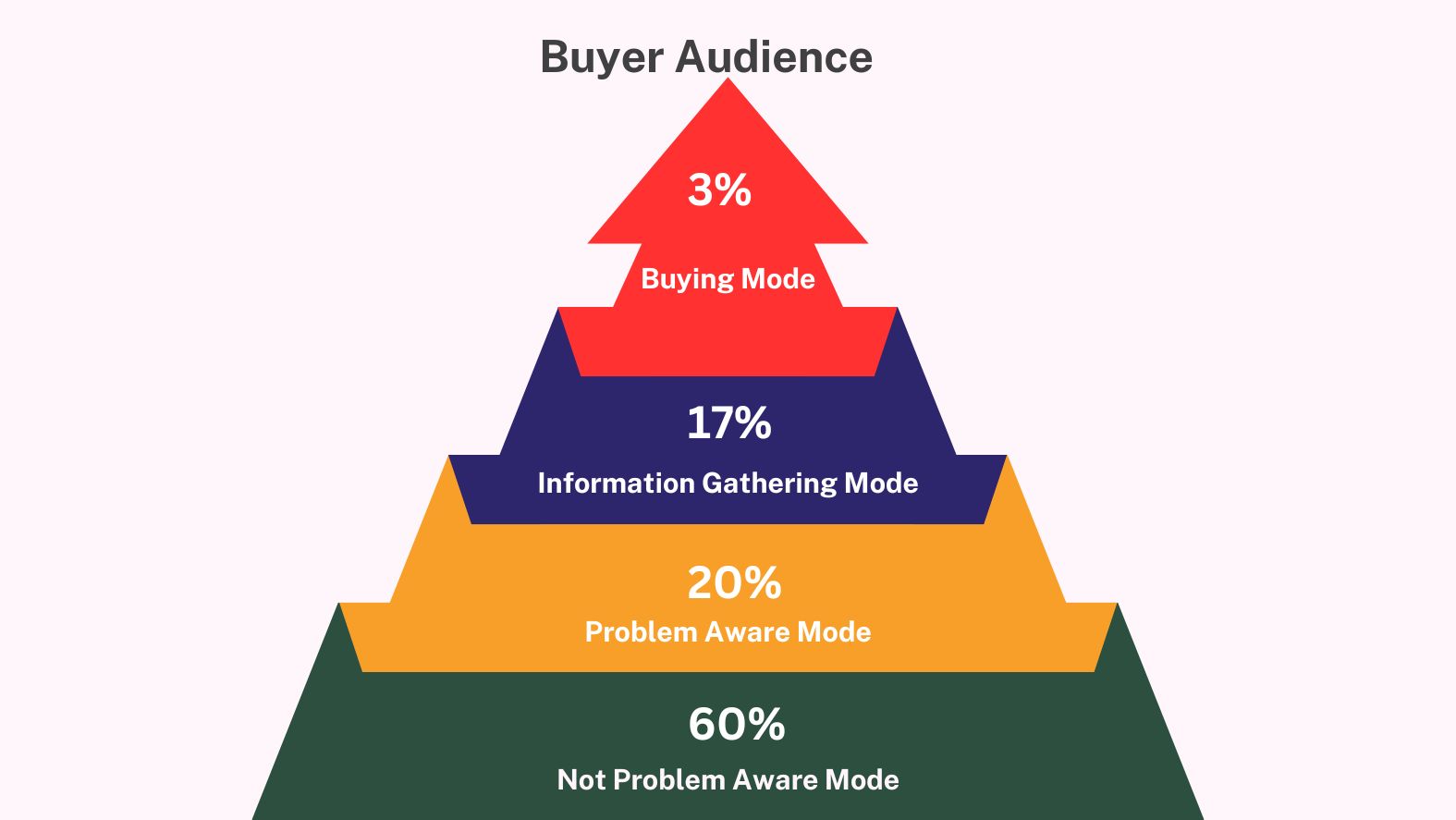
At any given moment, only 3% of the market is actively looking to make a purchase. You see ads targeting this group everywhere, with messages like "Best prices and largest selection!" These ads are straightforward: "I'm hungry." "Would you like this delicious burrito?" "Yes, please!" It's an easy sell. However, everyone is competing for this small group. Dividing this 3% among competitors means limited earnings.
The real potential lies in the 37% who are somewhat interested but undecided—17% are gathering information, and 20% are aware of a problem but not yet looking for a solution. Additionally, a massive 60% aren't aware they have a need yet. Understanding the Broader Market Approach allows you to capture this larger, often overlooked audience and turn them into loyal customers.
To engage the 97% who aren’t ready to buy immediately, you need to educate them. Uninformed prospects are hesitant to purchase. But the more they learn, the more likely they are to buy. By providing valuable information, you position yourself as the expert they turn to when they're ready to purchase.
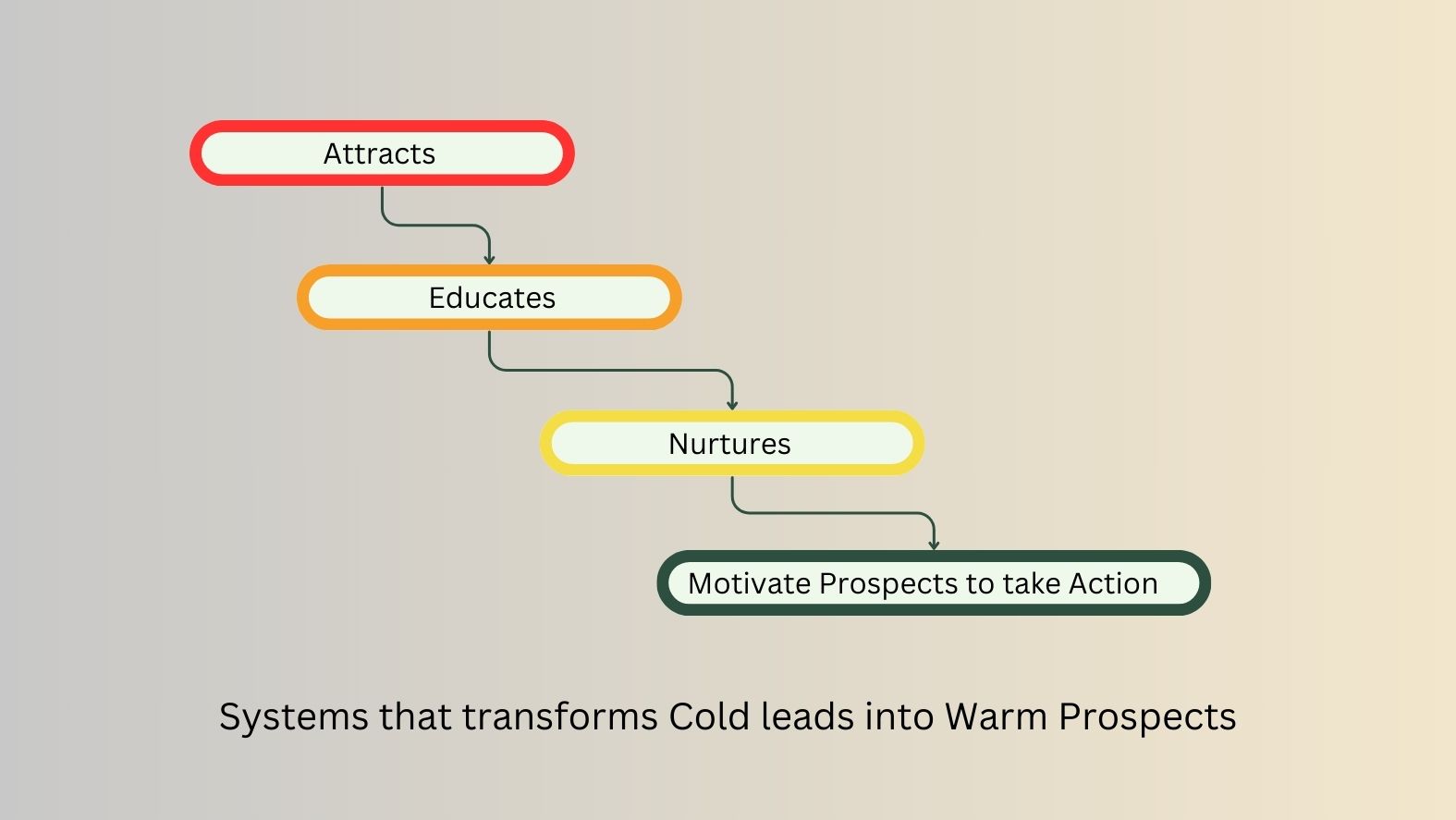
The goal is to create a system that:
1. Attracts
2. Educates
3. Nurtures
4. Motivates prospects to take action
This system transforms cold leads into warm prospects who are ready to buy. Instead of chasing clients, they come to you, already interested and informed. Your educational content does the heavy lifting, allowing you to focus on closing deals.
1. Educate Your Prospects: Provide valuable information that helps them make informed decisions. Use free reports, videos, or cheat sheets to offer high-value content.
2. Automate Nurturing: Turn your best sales pitches and FAQs into automated assets that nurture leads.
3. Make Irresistible Offers: Present your solution as the clear choice with compelling offers.
By effectively moving prospects up the pyramid, you can convert many of the 97% from "not buying right now" to becoming your customers. This approach allows you to engage potential clients before your competitors even have a chance. The best way to implement this strategy is through a sales funnel, which guides prospects from awareness to purchase over a few weeks.
A well-designed sales funnel converts uninterested visitors into loyal customers, potentially doubling your sales without increasing your advertising spend.
For instance Sarah, who runs a boutique coffee shop. Instead of only targeting the 3% actively searching for a new coffee place, she uses the Broader Market Approach. She creates engaging blog posts and videos about the benefits of different coffee beans, hosts online coffee brewing classes, and offers free downloadable guides on making the perfect cup at home. Over time, she educates a larger audience, turning casual coffee drinkers into loyal customers who visit her shop and buy her products online.
By understanding the full market potential and focusing on education and nurturing, Sarah's business sees a significant increase in sales and customer loyalty, far beyond what she could achieve by targeting only the active buyers.
Lack of Clear Understanding: Many businesses approach marketing like a “wing it approach”, without a solid grasp of how it works. This lack of understanding leads to wasted resources and missed opportunities. A strategic approach, based on a deep understanding of market dynamics, is essential for success.
Over-complication in Decision-Making: When too many stakeholders—writers, designers, executives—are involved in marketing decisions, the vision gets muddled, and the strategy loses its focus. Effective marketing requires a clear, unified direction and purpose.
Departmental Isolation: Often, different departments within a business operate in silos, leading to inconsistent branding and messaging. A unified marketing strategy necessitates collaboration across all departments to maintain a cohesive brand message.
Neglecting Market Research: Some companies skip market research due to its perceived cost or time requirements. However, understanding your target audience is crucial. Skipping this step means missing out on vital insights that could significantly enhance marketing efforts.
Mistakes in Global Expansion: When expanding globally, failing to understand cultural nuances can result in marketing blunders. Successful global marketing requires adaptation and localization to resonate with diverse audiences.
For instance, Starbucks is a prime example of a company that initially made mistakes in global marketing but adapted successfully. When Starbucks first entered the Chines market, they faced resistance because coffee was not a traditional beverage in China, and their standard store format didn't resonate with Chinse consumers.
However, Starbucks pivoted by learning and adapting to local preferences. They introduced more tea-based drinks and created a store environment that catered to local tastes, emphasizing a community-focused experience. They also incorporated local design elements into their stores and localized their menu to include items that appealed to Chinese customers.
Through these efforts, Starbucks successfully built a strong presence in China, becoming a favorite spot for social gatherings and adapting its brand to fit the local culture. This pivot from initial mistakes to a deep understanding of the local market allowed Starbucks to thrive and expand successfully in China and other international markets.
Expanding your market reach requires a strategic approach that goes beyond targeting the immediate 3% of active buyers. By understanding and educating the larger market, businesses can convert a broader audience into loyal customers. Avoiding common pitfalls such as lack of understanding, over-complication in decision-making, departmental isolation, neglecting market research, and global marketing mistakes can significantly improve your marketing effectiveness.
Embrace the Broader Market Approach to capture the full potential of your market, and watch your business grow by turning curious prospects into loyal, long-term customers.
If you have any further questions feel free to contact us. No obligations
Ready to expand your market reach? Sign up on Allfeito today!