-2024-10-29889.jpg)
A Comprehensive Guide on How to Write a Handyman Invoice
Learn how to create a clear, professional handyman invoice with this comprehensive guide, covering essential elements, t...
Successfully navigating the business landscape requires more than just having a great product or service. It involves understanding who your potential clients are and how to reach them effectively. After investing time and effort in identifying your Dream Buyer, developing a High-Value Content Offer (HVCO), creating an opt-in page, and presenting your Ultimate Offer, it’s time to delve into the next critical phase: Identifying and understanding your types of traffic.
Knowing your target audience and the various traffic you have is paramount for crafting compelling, click-worthy ads that will attract and convert prospects. This article will guide you through the different categories of potential clients and types traffic, helping you tailor your marketing strategies to meet the needs of your audience. By mastering this aspect, you can drive more targeted traffic into your sales funnel, ensuring a higher conversion rate and sustained business growth.
Most people don’t have a traffic problem; they have an offer problem. Offer bees salt, and they'll ignore you. Offer sugar, and they'll swarm. Traffic is out there—more traffic than you know what to do with. Accessing it is the key to aggressively marketing and growing your business, rather than just hoping for the best. But there are different types of traffic. You need to make your offer extremely enticing if you want them to click. Understanding where they are in the buying cycle—and what channel is best to reach them—is critical if you want to tailor a message to fit. Make sure your message matches the temperature of your audience!
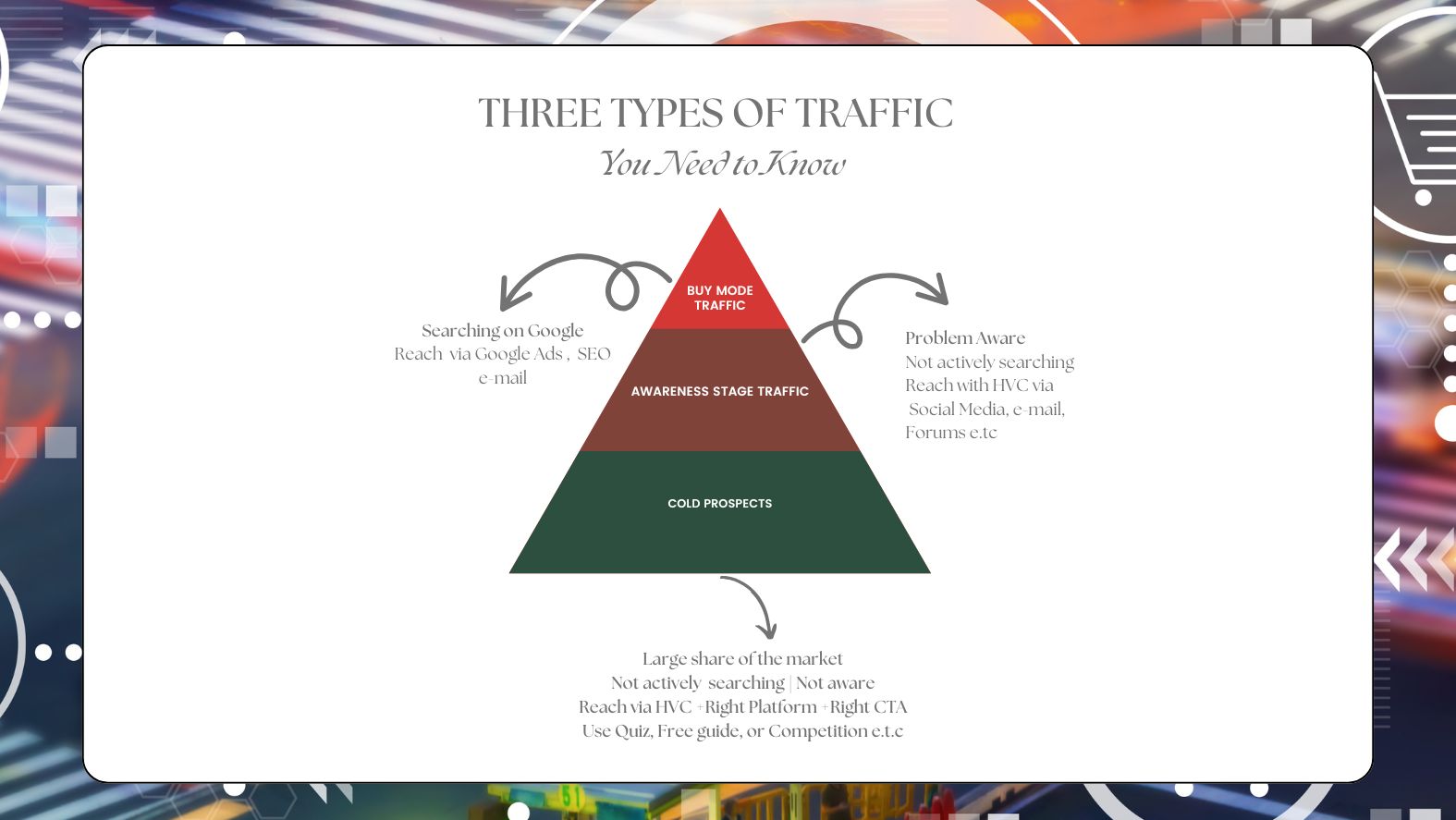
Buy Mode Traffic: These prospects are at the tip of the pyramid, actively searching on Google. They know they have a problem and are looking for a solution in the products and services you provide. These prospects are generally best reached through Google Ads or SEO and have very high purchase intent. They could also be on your email list or following you on Facebook.
Awareness Stage Traffic: These prospects are familiar with the challenges they face but are not actively searching or seeking solution. They might realize they need a new car but aren’t scoping car yards on the weekends just yet. Or someone who knows they need to lose weight but isn’t hunting for a personal trainer or a new diet program.
These individuals are open to buying but aren’t in search mode yet. Reach them through HVC on Social Media, e-mail, Forums etc. Engaging them with valuable content, such as insightful articles, case studies, or industry news, can capture their interest. Personalized messages that address their specific pain points and offer practical solutions can also be effective in initiating a meaningful conversation.
Building a relationship through consistent, thoughtful communication is key to turning their awareness into action.
Cold Prospects: This group isn’t searching and doesn’t even know they have a problem or a need, yet they are still good candidates for your products or services. They represent the largest segment of your market—60% of prospects sitting at the base of The Larger Market Formula pyramid. To capture a large share of the market, particularly among those who are not actively searching or aware of the problem your product or service addresses, it's crucial to employ high-value content (HVC) on the right platforms with the right call-to-action (CTA). Begin by identifying the platforms where your target audience spends the most time, such as social media, online forums, or industry-specific websites.
Use engaging content formats like quizzes, free guides, or competitions to draw them in. For instance, a well-designed quiz can intrigue users and provide immediate value, while a free guide can establish your authority and offer practical solutions. Competitions tap into the natural human desire to win, encouraging participation and sharing. Ensure your CTA is clear and compelling, guiding users towards the next step, whether it's signing up for a newsletter, downloading a resource, or entering a contest.
For example, if you offer a free consultation packed with value, it could go wrong if your prospects are cold and not ready for that level of commitment. If your message doesn’t speak to the temperature of your audience, it won’t work.
For cold customers, offer a more suitable call to action (CTA)and For hot customers, don’t beat around the bush—take them straight to the shopping cart. To convert your visitors, match the temperature of your audience.
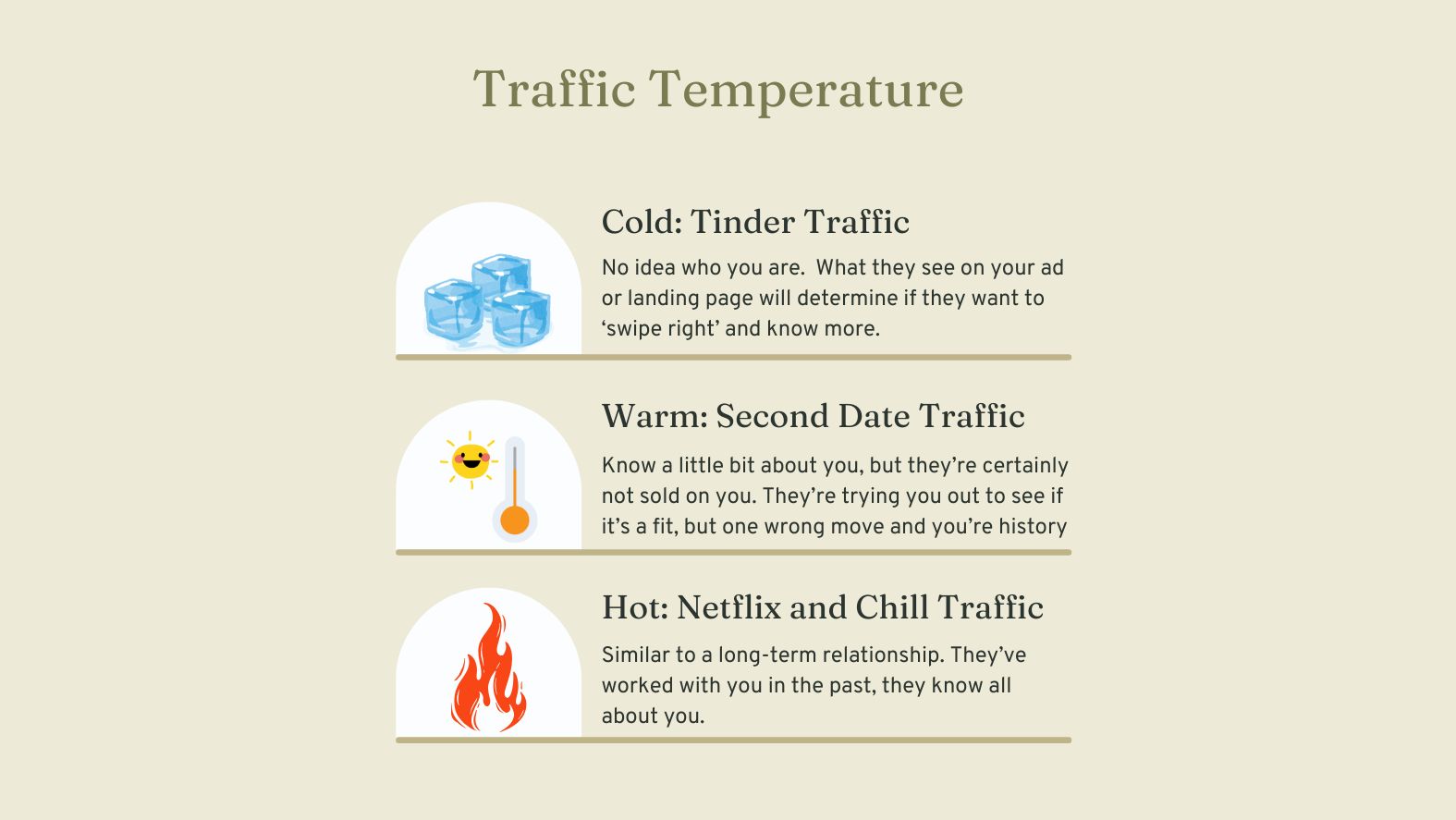
Cold: Tinder Traffic
Tinder Traffic refers to individuals who are unfamiliar with you. Just like a Tinder profile, you are essentially a stranger to them, and their interest in learning more will be based on what they see on your ad or landing page – akin to deciding whether to 'swipe right'.
· Tinder Traffic concept explained: how it relates to unfamiliar individuals.
· Drawing parallels between a Tinder profile and capturing interest through ads or landing pages.
· Emphasizing the importance of creating a compelling first impression to engage with this audience effectively.
The importance of creating a compelling first impression to engage with this audience effectively cannot be overstated. In the same way that a Tinder profile must capture attention within seconds, your ad or landing page must immediately grab the viewer's interest. This means using eye-catching visuals, concise and persuasive copy, and a clear call to action.
Just as a Tinder profile benefits from showcasing genuine personality and unique traits, your marketing materials should highlight what sets your product or service apart. Authenticity and relatability can significantly enhance your chances of converting this 'Tinder Traffic' into loyal customers.
Moreover, understanding your target audience's preferences and pain points is crucial. Tailoring your message to address these aspects can make your ad or landing page resonate more deeply. Think of it as crafting a profile that not only stands out in a crowded field but also speaks directly to the needs and desires of your potential matches.
Ultimately, the goal is to create a seamless and engaging experience that encourages further interaction. Whether it's through a well-designed landing page with easy navigation or an ad that tells a compelling story, every element should work towards building curiosity and trust. Just like in the world of dating, it's about making a connection that goes beyond the surface, leading to a meaningful and lasting relationship.
Warm: Second Date Traffic
Second Date Traffic is just like a second date. They’ve met you, they know a little bit about you, but they’re certainly not sold on you. They’re trying you out to see if it’s a fit, but one wrong move and you’re history. By establishing trust and offering value, it is possible to transform Second Date Traffic into devoted customers.
Hot: Netflix and Chill Traffic
Netflix and Chill Traffic represents an audience that resembles a long-term relationship. They have engaged with you previously, understand your brand well, and would spend all their time with you if possible.
When targeting Netflix and Chill Traffic with a Tinder message, they may feel it's overly personal since they are unfamiliar with it. Conversely, if you send a Tinder message to your Netflix and Chill audience, they might be offended, feeling unrecognized. For optimal conversions, assess your traffic's engagement level and tailor your message accordingly. Every aspect of your advertisement, offer, or landing page should be customized to enhance your connection with your audience. The aim is to transition them from Tinder to a deeper engagement level, akin to Netflix and Chill.
Similar to dating, marketing involves a series of steps and events that lead to a relationship progressing and becoming more serious. Just as the goal of dating is to find a life partner and get married through various stages, marketing follows a similar path. It begins with initial contact, perhaps at a party or through a mutual acquaintance. You engage in conversation, share interests, and exchange contact information. Subsequently, an invitation for a first date is extended, leading to subsequent encounters to deepen the connection.
Similarly, in business, the process involves gradually building trust and commitment before making a purchase. Rather than rushing into a sale, businesses should focus on nurturing leads, providing value through education, and only then asking for a purchase. Many businesses make the mistake of pushing for a sale too quickly, akin to proposing marriage on the first encounter. It's essential to establish a rapport and build value before urging prospects to buy, rather than overwhelming them with immediate sales pitches.
Here's how each fits into the broader context of a sales funnel:
An Ad is often the first step in a sales funnel. It serves to attract potential customers and drive traffic to the next stage of the funnel, typically an opt-in page or landing page. The ad is designed to capture attention and compel the viewer to click through.
An Opt-In Page is a crucial part of the sales funnel. It collects contact information from visitors, such as their email addresses. By offering something of value (a lead magnet) in exchange for this information, businesses can convert visitors into leads. The opt-in page usually comes after the ad and is focused on capturing leads to nurture them further down the funnel.
A Landing Page is a standalone web page created specifically for a marketing or advertising campaign. It is designed to drive visitors to take a specific action, such as signing up, making a purchase, or downloading a resource. In a sales funnel, a landing page can be used at various stages, often immediately after the ad to convert traffic into leads or customers.
A Sales Mechanism refers to the methods and processes used to convert leads into paying customers. This can include webinars, sales calls, automated email sequences, or online sales pages. It's a critical part of the sales funnel that moves leads from the consideration stage to the decision and purchase stages.
Together, these components create a structured path (sales funnel) that guides potential customers from the initial point of contact through to conversion and beyond.
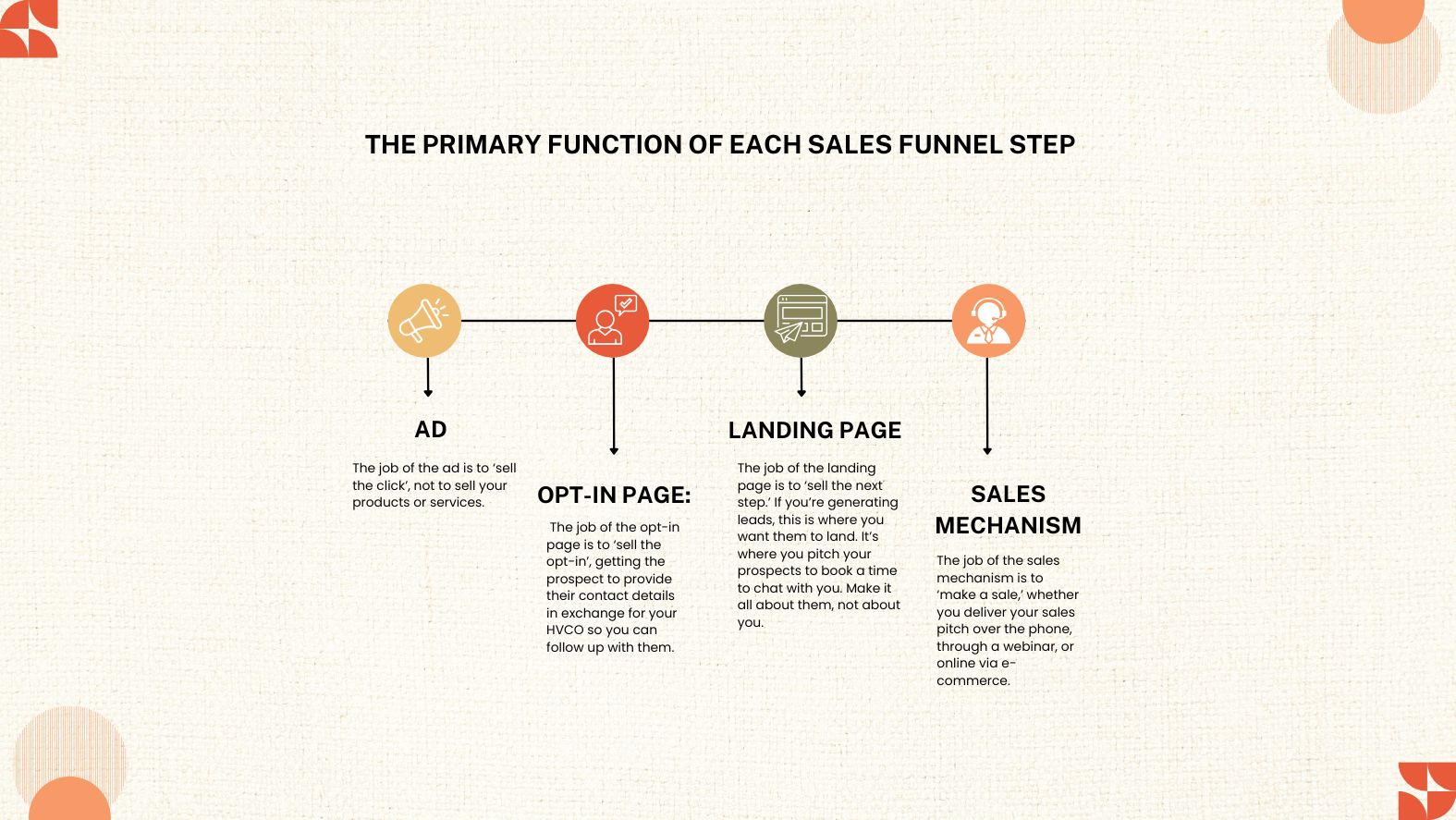
Whether you’re advertising on Google, Facebook, Instagram, or YouTube, the first step in the process of turning disinterested wanderers into your most valuable dream clients is getting eyeballs on your ads.
· Ad: The job of the ad is to ‘sell the click’, not to sell your products or services.
· Opt-In Page: The job of the opt-in page is to ‘sell the opt-in’, getting the prospect to provide their contact details in exchange for your HVCO so you can follow up with them.
· Landing Page: The job of the landing page is to ‘sell the next step.’ If you’re generating leads, this is where you want them to land. It’s where you pitch your prospects to book a time to chat with you. Tip: make it all about them, not about you.
· Sales Mechanism: The job of the sales mechanism is to ‘make a sale,’ whether you deliver your sales pitch over the phone, through a webinar, or online via e-commerce.
The ad might be on Google Ads, Facebook Ads, YouTube, Instagram, TV, or print advertising. It doesn’t matter which channel or if it’s online or offline—the premise is always the same. The job of an ad is not to make a sale. Its one and only job is to funnel prospects off the medium they’re on—Google, Facebook, etc.—by getting them to click. Nothing else. Before selecting which channel you’ll utilize, ensure the channel is right for the temperature of the prospect you’re targeting.
Targeting prospects in buy mode is best done using either Google Ads or SEO, focusing on those super-high purchase-intent keywords and phrases. Here, you’re specifically targeting the prospects who are fully aware they have a need and are just searching for the right person to do business with.
Targeting prospects in the awareness stage can be done using various platforms, including Google, LinkedIn, and Instagram. People are getting more specific in their searches, and these prospects have already sold themselves. They know they have a problem; they’re motivated and out there looking for a solution.
Cold prospects represent the largest segment of your market and can be accessed through Google, LinkedIn, Instagram Ads, Facebook, or YouTube. Targeting these prospects is ultimately where the biggest potential lies long-term, but to warm them up, you’ll need a clever sales funnel with information-based content. Your sole purpose is to get the attention of these prospects as they’re racing past in that stream.
If you have any Questions, feel free to Contact Us—No obligations.
Become a member of Allfeito & Expand your business effortlessly!