
How to Capture and Nurture Leads Effectively for Your Busine...
Master the art of capturing and nurturing leads with proven strategies to grow your business. Turn prospects into loyal...

In the competitive landscape of business, having a powerful strategy that sets you apart from the rest is crucial. One such strategy, often overlooked by many businesses, is The Ultimate Offer. This game-changing technique, a closely-guarded secret in the realm of sales and marketing, consistently delivers unprecedented results. Its unmatched potency has the potential to double or even triple the profit of almost any sales message, regardless of the product or service, and in any market.
The Ultimate Offer isn't just about enhancing your current efforts; it transforms even the weakest traffic sources into a goldmine of eager, ready-to-buy customers. This strategy empowers businesses to excel across multiple industries and markets, consistently outperforming and surpassing well-established competitors. By integrating The Ultimate Offer into your marketing arsenal, you unlock the key to not only meeting but exceeding your business growth objectives.
An Offer They Can't Refuse
The core of this strategy revolves around creating an offer so compelling that prospects find it nearly impossible to refuse. An offer consists of two components:
1. What your prospects want when responding to your marketing.
2. What they need to do to get it.
This is where 99% of businesses fail—they don't motivate their prospects with an irresistible offer. Most businesses generate leads or offer a free report, but they are surprised when people don’t immediately make a purchase. The reason is simple: their offers are not compelling enough.
This strategy is about making bold claims and big promises. It’s about having an offer so white-hot that it melts objections and removes any barriers to the sale. Unfortunately, most business owners start from a position of weakness, offering vague and uninspiring promises. This approach is ineffective and fails to stand out in the competitive marketplace.
Here’s how to create an offer that demands attention and practically forces your prospects to buy.
Sell What People Want to Buy
In the past, businesses relied heavily on face-to-face interactions in local markets to sell products and services. Merchants would engage directly with customers, tailoring their pitches to meet the immediate needs and desires of those in their communities. Today, the landscape has shifted dramatically with the advent of the digital world. Now, businesses must navigate a vast and ever-changing online marketplace, where competition is fierce and customer expectations are higher than ever.
Consumers are now accustomed to getting the best offers upfront with minimal interaction. Therefore, the first step is to sell what people want to buy. This might seem elementary, but many businesses overlook this fundamental principle. They focus on their own interests rather than what the market desires. They fail to ask, ‘What is the market starving for?’
Creating a Detailed Feature and Benefit List
To craft a compelling pitch, start with a detailed list of features and benefits of your product or service. This exercise will help you understand the true value of what you’re offering. A feature is a specific detail or specification, while a benefit is what that feature does for the customer. Translate each feature into a benefit to create a robust list that will inform your offer.
Consider a company that sells and rents solar panels. Here, the features and benefits can be outlined as follows:
Features:
· High-Quality Solar Panels: Manufactured to the highest standards, ensuring top-notch performance and longevity.
· Very Light: Designed to be lightweight, making them easier to handle and install.
· Easy to Install: Installation is straightforward and quick, reducing the time and complexity involved.
· Made of Durable Recycled Materials: Enhances durability and supports environmental sustainability.
Benefits:
· Option to Buy or Rent: Flexibility allows customers to choose a plan that best suits their financial situation and long-term needs.
· Professional Installation Included: Expert installation services ensure that the panels are set up correctly and efficiently, providing peace of mind.
· Significant Savings on Electricity Bills: Switching to solar energy can save customers up to 80% on their electricity bills, leading to substantial financial savings over time.
· Opportunity to Sell Excess Energy: Customers can sell any excess energy generated back to the grid, creating an additional revenue stream and further maximizing their investment.
Communicating Features and Benefits
When creating an offer for your products and services, it's crucial to lead with the benefits, as these are what truly resonate with customers. While features provide the technical details that some customers might find interesting, benefits answer the question, "What's in it for me?" This approach helps potential buyers understand how your product or service will make their lives better, solve their problems, or meet their needs.
For example, instead of simply stating that your solar panels are "easy to install," you could say, "Our solar panels are easy to install, so you can start saving on your energy bills immediately without the hassle of a complicated setup." This not only highlights the feature but also ties it directly to a tangible benefit, making the value proposition clear and attractive.
Building Trust Through Benefits
Emphasizing benefits also builds trust and credibility. When customers see that your product can save them money, offer flexibility, and support environmental sustainability, they are more likely to view your brand as a reliable and forward-thinking provider. This trust is crucial in today's competitive market, where consumers have a plethora of options and are often skeptical of marketing claims.
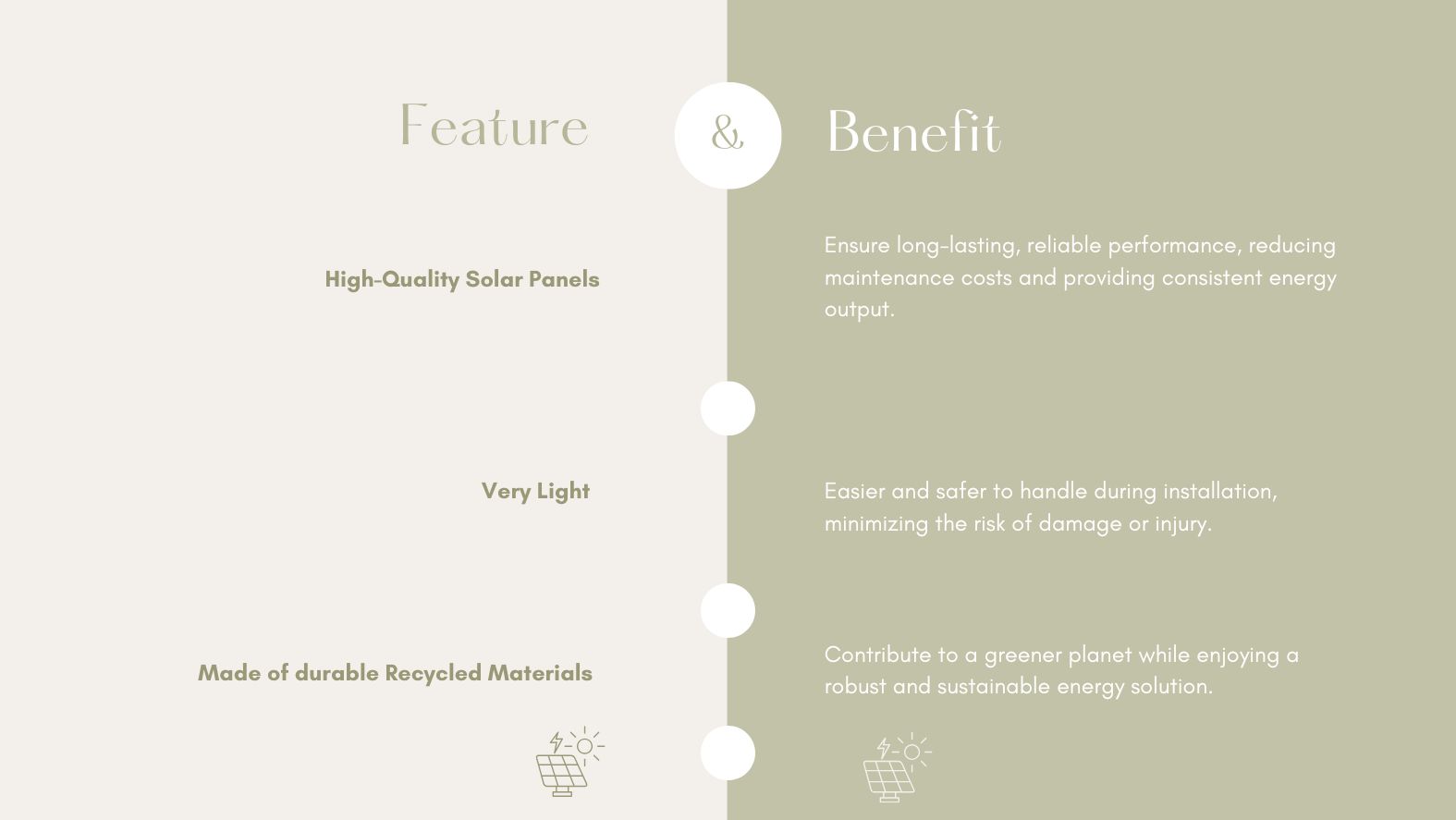
In practice, when developing your offer, always aim to translate features into benefits. For instance:
Feature: High-quality solar panels
o Benefit: Ensure long-lasting, reliable performance, reducing maintenance costs and providing consistent energy output.
Feature: Very light
o Benefit: Easier and safer to handle during installation, minimizing the risk of damage or injury.
Feature: Made of durable recycled materials
o Benefit: Contribute to a greener planet while enjoying a robust and sustainable energy solution.
By focusing on how your product improves the customer’s life or business, you make it more compelling and increase the likelihood of converting prospects into satisfied customers. Next, develop your offer.
Creating a robust offer is the cornerstone of your business proposition and the most vital element of your sales message. It needs to be specific, bold, and compelling. Begin by brainstorming the most powerful offer you can imagine, then refine it to ensure it’s both irresistible and feasible. Your offer should be so strong that it generates excitement and curiosity among your prospects.
Imagine you have a magic wand to create a dream service for your clients without any legal or logistical constraints. What would you offer? Start with this ideal scenario and then narrow it down to tangible services you can provide. Those seemingly unattainable ideas might become valuable assets as your business grows and evolves.
Your offer should comprehensively answer the following questions:
· What are your products and services?
· How much do they cost?
· Who is your target customer?
· How do customers buy or access your services?
When developing your offer, conduct a thorough analysis of how competitors present theirs. Often, you will find that 90% of offers are weak, targeting only a small fraction of the market (around 3%), leaving the vast majority (97%) unengaged.
In some cases, businesses don’t just need a strong marketing strategy; they need an internal audit and structural changes to effectively implement strategies that deliver outstanding results.
Consider this example from a landscaping company we assisted. Their initial offer was, "Get a free estimate for your garden makeover." This offer was vague and uninspiring. After refining their marketing strategy, we crafted a more compelling offer: "Transform your garden into a stunning oasis in just two weeks, or get $1,000 back!" This revised offer was specific, risk-free, and highly appealing, addressing the common issue of landscaping projects that drag on indefinitely. It also included detailed pricing and service packages, dispelling the myth that hiring a landscape designer is prohibitively expensive. This enhanced offer helped the company achieve significant growth.
Another example is a painting service. A weak offer might be, "Quality painting services for your home." A stronger, more compelling offer could be, "We’ll paint your house in one week or give you $500 off your bill." This offer addresses a specific pain point and provides a clear, attractive incentive.
A strong offer can thrive even with a mediocre copy, but an exceptional copy cannot compensate for a weak offer. No matter how sophisticated your marketing efforts are, they will fail without an irresistible offer. A powerful offer allows you to command higher fees and stand out in a crowded market. In short, the key to a successful offer is to eliminate all friction and make it an easy decision for prospects to choose you.
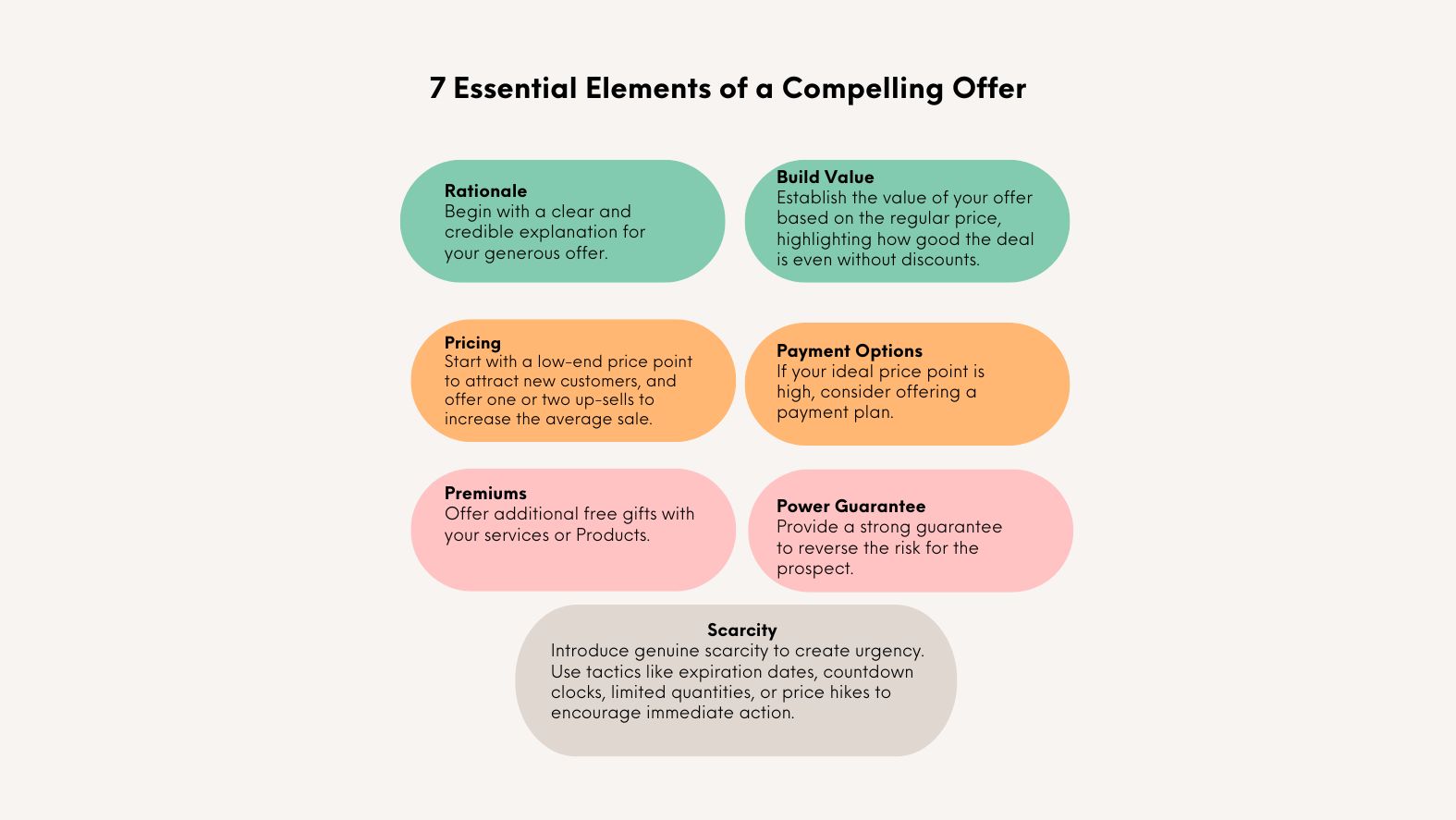
A compelling offer, consists of seven key elements that bring its brilliance to life:
Rationale Begin with a clear and credible explanation for your generous offer. Whether it's a "Special Introductory Offer" or an efficient business model allowing for cost savings, make your reasoning explicit. This builds trust and makes your offer believable.
Build Value Establish the value of your offer based on the regular price, highlighting how good the deal is even without discounts. Provide proof, such as screenshots or customer testimonials, to support your claims. Detail the benefits your product offers at full price before introducing the discount.
Pricing Start with a low-end price point to attract new customers, and offer one or two up-sells to increase the average sale. Use a "loss leader" strategy if necessary, offering an introductory product .For instance, a premium fitness app could provide free access to basic workout routines but charge for advanced training plans and personalized coaching sessions.
Payment Options If your ideal price point is high, consider offering a payment plan. Breaking the cost into smaller monthly payments makes the price more manageable for prospects, increasing the likelihood of a sale.
Premiums Offer additional free gifts with your services or Products. Premiums can double or triple your sales by adding extra value. For example, a home-building company might offer a $5,000 furniture and appliances voucher, while a car detailing company could include new floor mats.
Power Guarantee Provide a strong guarantee to reverse the risk for the prospect. A specific guarantee tied to the performance of your product can be very effective. For instance, "If we don't complete your home renovation within 90 days, we'll give you $2,000 back."
Scarcity Introduce genuine scarcity to create urgency. Use tactics like expiration dates, countdown clocks, limited quantities, or price hikes to encourage immediate action.
After defining your offer, anticipate and overcome potential objections from prospects. Address these concerns directly in your offer to reduce any hesitations. Make your offer as irresistible as possible by ensuring your copy is clear and direct.
By focusing on what your market wants and packaging it in the most compelling way, you can significantly enhance the effectiveness of your sales efforts. Once you see the impact of a well-crafted offer on your bottom line, you'll appreciate the power of this strategy.
If you have any questions, feel free to contact us—no obligations.
Don't miss out on potential clients. Join Allfeito today & expand your client base!
-2024-10-29647.jpg)