-2024-10-29647.jpg)
How to Become a Landscaper
Discover the steps to becoming a professional landscaper, from essential skills and training to building a portfolio and...

A strong guarantee is often the deciding factor for customers when choosing between products or services. It's not just about the quality or effectiveness of what you're offering, but the promise that backs it up. Reputable businesses often provide robust guarantees, and this assurance encourages customers to take the plunge, knowing the risk is assumed by the seller. Imagine, would you choose a product with a clear guarantee or one that vaguely promises quality without backing it up?
To significantly transform your business, consider implementing a solid guarantee for your products and services. If you can't confidently stand behind what you offer, how can you expect your customers to trust you? A guarantee eliminates sales resistance, builds trust, and fosters goodwill. Many business owners understand the concept of a guarantee but shy away from it due to uncertainty about their product's performance or fear of customer exploitation.
Some businesses hesitate to offer guarantees because they're not confident their products can deliver on marketing promises. For instance, you might promote a solar power system claiming it will save 80% on electricity bills, but without confidence in this outcome, guaranteeing it feels risky. Others worry about customers taking undue advantage of lenient guarantees, as was the case with Nordstrom's overly generous return policy, which they eventually had to tighten to prevent fraud.
However, legal frameworks in most countries mandate some level of consumer protection. If a product is defective or doesn't perform as advertised, consumers are entitled to compensation or repair. This means a basic guarantee is inherently built into every sale. Given this, why not leverage it to your advantage? Advertising your guarantee can reduce buyer hesitation and enhance your sales appeal.
Addressing skepticism is crucial. Your potential customers have likely experienced disappointment and deception before. Without a clear guarantee, you're asking them to bear all the risk, which reflects poorly on your business. To scale successfully, especially when targeting cold traffic—people who don’t yet know, like, or trust you—you must mitigate this risk. These individuals need assurance that their purchase is safe and that your product will meet their needs.
To protect your business from exploitation, structure your guarantee with precise terms and conditions. Make it compelling but not overly lenient. For professional services, consider offering additional services until satisfaction is achieved instead of financial reimbursement. This approach ensures your guarantee is strong enough to attract customers while safeguarding your business against potential abuse.
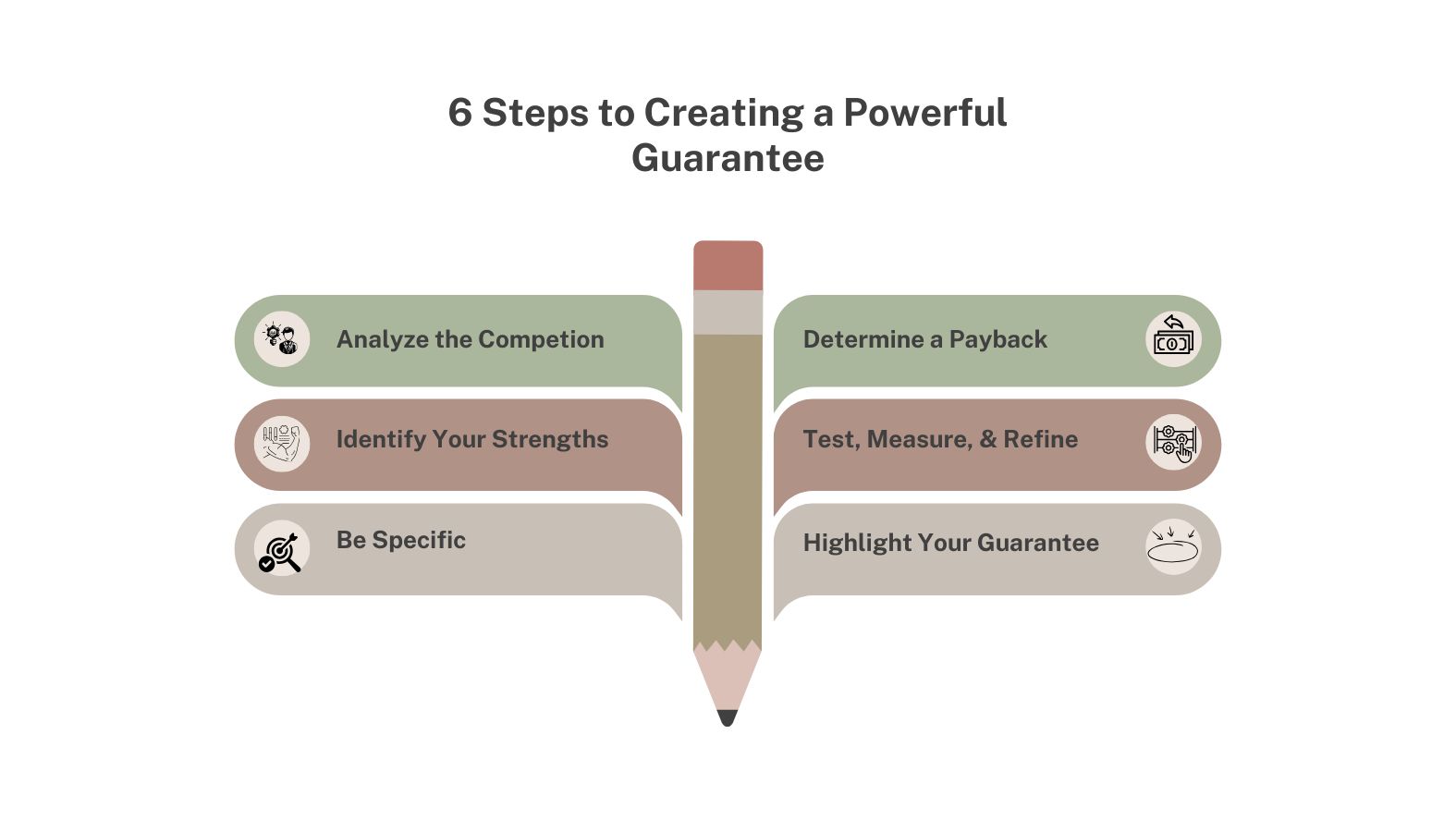
6 Steps to creating a Power guarantee
Here’s a systematic approach to crafting an impactful guarantee or enhancing an existing one:
1. Analyze the Competition: Conduct a thorough search of your industry to understand what types of guarantees your competitors are offering. Use search engines to find businesses in your field and study their guarantees. Extend your research by calling these businesses to gather detailed information. Look beyond your immediate industry or geographic location for exceptional guarantees. Document your findings, noting trends and the prevalence of guarantees. Are there specific performance-related guarantees, or are they generic, such as 'satisfaction guaranteed'?
2. Identify Your Strengths: Focus on the unique strengths of your business. Do you deliver results quickly? Is your craftsmanship unparalleled? Do you excel in fast installations or superior maintenance? Does your product or service consistently produce outstanding results, or save customers time or money? Highlight the aspects where you outperform your competitors and base your guarantee on these strengths.

1. Be Specific: Tailor your guarantee to address the precise outcomes your customers seek or the problems they aim to solve. Avoid vague terms like 'satisfaction'; instead, provide a specific, measurable promise. Clearly define and detail the benefits your customers will experience, making your guarantee both explicit and measurable.
Here are a few Examples:
Painting Services: "We guarantee a flawless finish on every wall, or we'll repaint the area for free. If you notice any peeling or fading within the first two years, we’ll fix it at no extra cost."
Roofing Services: "Our roofing comes with a 10-year leak-free guarantee. If you experience any leaks within this period, we will repair them promptly at no charge."
Flooring Installation: "We guarantee that your new hardwood floors will remain level and creak-free for at least 5 years. If there are any issues, we'll repair them free of charge."
Kitchen Remodeling: "We promise your kitchen renovation will be completed on time and within budget. If we exceed the agreed timeline, we will deduct 5% from your final bill for each additional week of delay."
Plumbing Services: "We guarantee no clogs or leaks for a full year after our plumbing installation. If you encounter any issues, we'll resolve them quickly at no extra cost."
By providing specific guarantees like these, you not only build trust with your customers but also set clear expectations and demonstrate confidence in the quality of your services. This specificity can significantly increase your appeal to potential clients looking for reliability and value in their home improvement projects.
2. Determine a Payback: Although it's rare that customers will claim on guarantees (less than 5% do), you need to offer an appealing compensation for those who do. Ensure that the payback has a high perceived value but low cost to you. Your guarantee should exceed customer expectations, creating a memorable experience and eliminating perceived risk.
3. Test, Measure, and Refine: It’s crucial to evaluate the effectiveness of your guarantee before making it a core element of your offer. Test your guarantee across various platforms, such as different landing pages or advertising channels (Google, Facebook, YouTube, Instagram). Analyze the results, measure performance, and refine your guarantee based on data. Compare sales figures before and after introducing the guarantee. Experiment with different durations (e.g., 30-day vs. 90-day guarantees, or even lifetime guarantees) to determine which version yields the best results.
4. Highlight Your Guarantee: Once you've fine-tuned your guarantee and found a winning formula, prominently display it in all your marketing materials. Feature it on your website, landing pages, proposals, advertisements, brochures, and any other customer touchpoints. Ensure that your guarantee is visible and compelling, reinforcing trust and encouraging customer engagement.
Here are more examples:
Double Your Money Back: "If our product doesn't perform as promised, we'll refund double your money back."
On-Time Delivery Guarantee: "We guarantee your order will be delivered on time, or it's free."
Performance Guarantee: "See a 20% increase in efficiency within three months, or we'll refund your entire payment."
Lowest Price Guarantee: "Find a lower price elsewhere? We'll match it and give you an additional 10% off."
No-Questions-Asked Return: "Return any item within 90 days, no questions asked, for a full refund."
Customization Guarantee: "We guarantee your custom order will be exactly as specified, or we'll remake it at no extra cost."
If you have any questions, feel free to Contact Us—No Obligations.
Ready to boost your business? Join us today and discover what Allfeito can do for you!
-2024-10-28656.jpg)