
Customer Relationship Management: The key to Long Term Succe...
Explore how effective customer relationship management (CRM) is crucial for achieving long-term success. Enhance your st...
-2024-10-28976.jpg)
The Guide To Hiring Your First Employee
Revolutionize your Trade or Service Provider business in Portugal with our in-depth guide on hiring your first employee for seamless home improvement projects. Gain invaluable insights tailored for tradesmen and service providers, as we dive into everything you need to know to elevate your skills, streamline operations, and maximize success.
Sole trader and rushed off your feet? Turning away jobs because you haven’t got enough hands on deck? These could be signs you need to hire your first employee.
Make no mistake, it’s a big step becoming an employer, but it can lighten the load and allow your business to expand. The important thing is to get your head around what is involved, including your legal obligations. You also need to decide if you want a permanent staff member, part-timer, contractor – or maybe even an apprentice.
But you need to be able to afford an employee, and find the right person for the job. It could be the difference between your trade business doing just OK or thriving.
Let’s start by covering some signs you need another pair of hands.

5 Signs you need to hire a new employee
If any of these apply to you it’s very likely your trade business needs another pair of hands.
Let’s now look at the difference between a full employee and a contractor, because there are pros and cons to both options.
What are the benefits of hiring an employee vs a contractor?
You may be wondering if you should hire a contractor or subcontractor instead of a full time employee. It’s a fair point, so let’s cover the pros and cons of each.
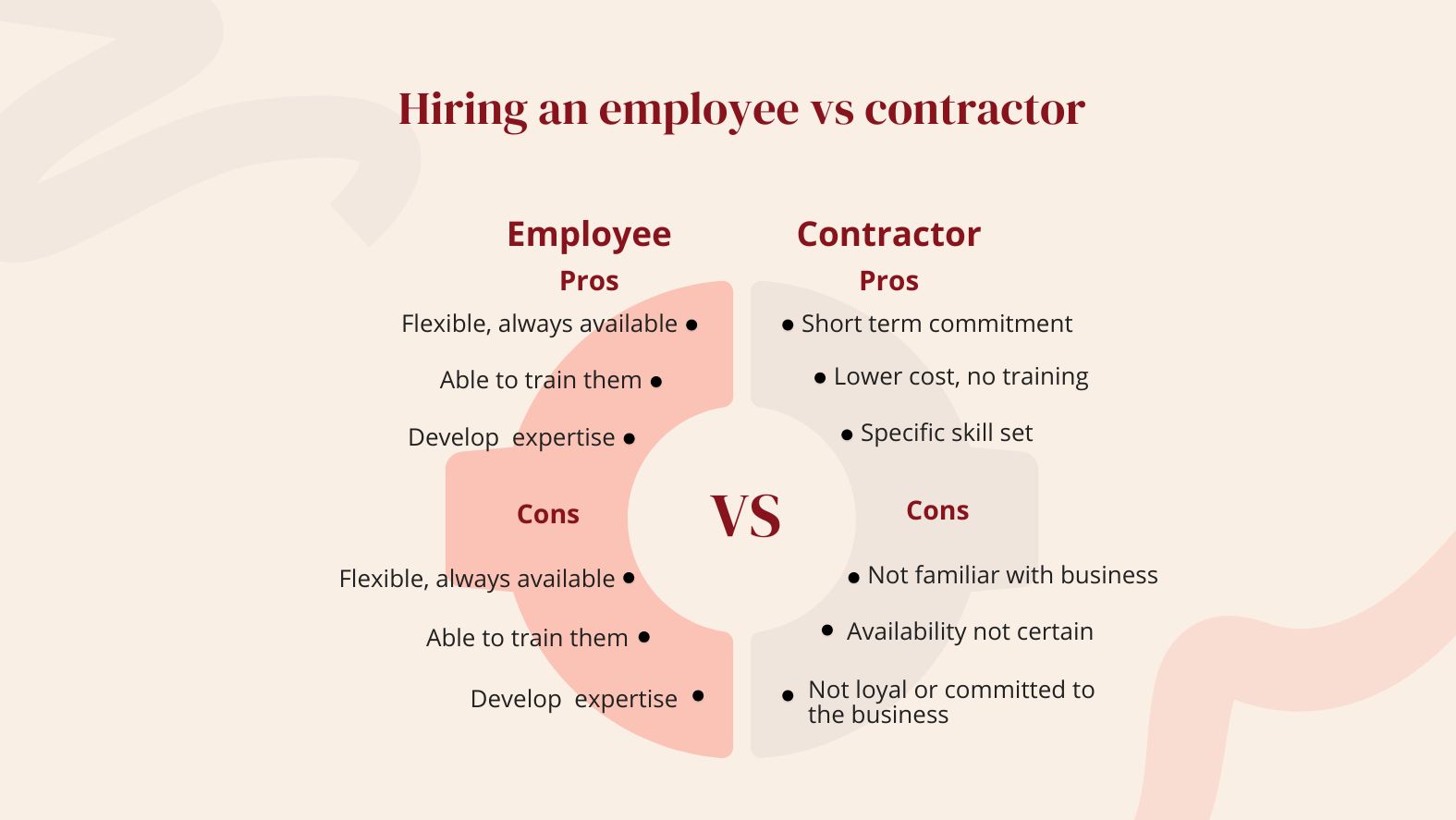
Employees work for your business, doing a specific job on an open-ended, permanent contract. This means they are on your payroll and you have to take care of their super, as well as benefits like sickness and annual leave. They are a bigger financial commitment, but in the long run you are going to get more out of their expertise in the business.
Contractors are self-employed, and only get paid for a specific job over a defined time frame. They receive no benefits from you, and need to take care of things like super and tax themselves. There is a definite cost benefit with a contractor, and you don’t have to train them – especially if you just need their skills occasionally.
Next, you need to be able to spot that diamond in the rough, and hire someone with the right attitude and skills for your business.
What to look for in a new employee?
Your future employee should be a good ‘fit’ for your business. You also need to be able to get on with them and trust them. It’s a tough call because you may only have half an hour or so with them in an interview.
Ideally look for someone who:
At the end of the day go with your gut, but don’t forget to check their references out. Previous employers can give you a good idea if they are solid grafters and if they know what they are doing.
Now we’ve covered what type of person you are looking for, let’s look at the actual process itself, including all the legals and paperwork.
Your checklist for hiring your first employee
There is a lot to think about when you become an employer, but remember – it’s worth it in the long run.
Here’s a checklist of what you need to get your head around, including costs like wages, lunch and tax – and all the other legal steps and paperwork you have to be on top of.
Decide the type of employee you want to hire:
Full time, part-time, casual, temporary? Or you could take on an apprentice. This will depend on what you can afford, as well as the current and future needs of your business.
The cost of a new employee
This includes hiring costs, wages, allowances, overtime, holiday pay, workers' compensation insurance, tax and lunch etc.
The wages of the new employee
And all their other entitlements like lunch, tax etc.
Hiring the employee
Make sure they are legally allowed to work in Portugal, and have the right license and qualifications for the job.
Onboarding the employee
It's crucial to set expectations so they know what is expected of them and how your business operates. This includes the hours you expect them to work.
Register for tax
This is so you can withhold this portion of their wages and forward it to the Financas. You are also liable to pay their super, which applies to full-time, part-time and casual employees.
Keep records about your employee
Specifically their tax, super and employee history - all which are required by law. You should also be realistic, in case it all heads south, and know what is involved if you need to let them go, including the dismissal process, notice periods and their final paycheck.
Ready to take your Trades business to the next level? Join our comprehensive home improvement platform, connecting homeowners and tradesmen, and stay ahead in the evolving landscape of Portugal home renovations & construction industry.
-2024-10-28718.jpg)